Coverage of the border collie method for Canada goose control, from Long Island to national and international press.
The border collie approach to Canada goose control has drawn steady press attention over the past decade, from local Long Island coverage to national newspapers and trade publications. Geese Chasers LI NY LLC has served Nassau, Suffolk, and Queens counties since the Long Island franchise opened in 2014, applying the same method covered in the stories below. Here is what that coverage has reported, starting with the Long Island story and working outward.
Long Island Coverage

CBS New York: Brightwaters Village Turns to Dogs
In August 2018, CBS New York covered the village of Brightwaters, where five interconnecting lakes had made the community a magnet for resident Canada geese. The village put dogs to work on its bay beach to keep the sand usable. Michael Mallek, owner of Geese Chasers LI NY LLC, explained in the segment that birds gradually learn a property is no longer safe once a dog is working it daily. The piece also noted the New York State Department of Environmental Conservation’s position that Canada geese are protected under state and federal law, and that permanent removal requires permits, which is a large part of why non-lethal methods get used on Long Island in the first place.
Read it: CBS New York: Long Island Town Struggling In Battle Against Canada Geese
National Press

The New York Times: How the Method Works
An April 2023 interview with founder Bob Young covered the reasoning behind the breed choice. Border collies work because geese read them as arctic foxes, their main natural predator. Young told the paper he had tried Australian shepherds and Labs first and the geese were not bothered by them. The article also reported on a tracking study the company ran over twelve weeks, which found geese stayed away roughly two weeks after two chases and four weeks after four chases. It cites BirdLife International data putting the North American goose increase at 1,500 percent over forty years, and a federal estimate of 15 to 20 percent annual growth. One detail in the piece is worth attention for anyone managing turf: geese pull grass up by the roots when they feed, and their droppings are acidic enough to shift soil pH, so damaged areas often come back as hardy weeds rather than grass. The article also mentions crews working Central Park, typically for only a couple of hours early in the morning.
Read it: The New York Times: His Business? Hiring and Managing Dogs to Chase Geese.

The Times of London: Why the Population Grew
A week later, the UK paper covered the same industry from a different angle, focusing on how the Canada goose went from a protected species to an everyday nuisance. It traces the population from roughly a quarter million in 1970 to about 3.5 million by 2010, and points to the Migratory Bird Treaty Act as the protection that enabled the recovery. The piece also notes how corporate parks and their landscaped retention ponds created close to ideal habitat, a pattern familiar to anyone managing property on Long Island. It also covers the sanitation side, noting that goose droppings can carry bacteria including E. coli, which is the reason beaches, ball fields, and shoreline parks tend to be the properties that act first.
Read it: The Times: Want to get rid of a goose? Take a gander at these border collies
Business and Trade Coverage
ROI-NJ: How Service Is Actually Structured
This February 2023 profile is the most useful of the group for property managers, because it covers logistics rather than origin story. It reports that service typically runs daily in the opening weeks and then drops to once or twice a week, that the number of ponds on a property matters more than raw acreage, and that contracts at the parent company ranged from about $250 to $4,500 per month depending on scope. It also flags mid-February through mid-March as the window to have service in place, before geese nest. Note that those figures reflect the New Jersey headquarters, not Long Island pricing.
Read it: ROI-NJ: Meet Bob Young, South Jersey man who stumbled into service

Golf Course Industry: Franchise Growth
Written for golf course superintendents, this October 2021 piece covered the Northern Virginia franchise opening under Army veteran Bill Edwards and recapped the company’s growth from a single course in the late 1990s to eight locations. It notes the founder’s first dog cleared more than 200 geese in a week, and that the first franchise sold in 2011. For turf managers, the relevant detail is that goose damage on a course is not just droppings: geese pull grass up by the roots when they feed.
Read it: Golf Course Industry: Geese Chasers opens in Northern Virginia
Broadcast Segments


The method has also been covered on television and in digital video. CBS2 ran a segment on the dogs at work, and AOL’s In The Know series featured the company as well. Both are short watches that show the chase in progress, which is often more convincing than a written description for property owners deciding whether the approach will actually work on their site. Watch the CBS2 segment or watch the AOL In The Know feature.
What the Coverage Adds Up To
Read together, these stories make a consistent case. The goose population on Long Island and across the region is resident rather than migratory, so it does not simply leave. Federal and state protections rule out most permanent removal without permits. And the methods that do work are the ones that change the birds’ assessment of a property over repeated visits, rather than a one time fix.
That last point is the one property managers most often miss. Coverage across these outlets repeats the same finding: geese come back. Consistent, scheduled visits are what keep a property clear, which is why service is structured as an ongoing program rather than a single appointment.
One distinction is worth drawing out. Most of the national and trade coverage above profiles the parent company and its founder, so the specific figures in those stories, including service pricing and client counts, describe operations in New Jersey and other markets rather than Long Island. The CBS New York segment is the coverage that reports directly on work done here, on a Long Island property, by the local franchise. For Nassau, Suffolk, and Queens properties, scheduling and pricing are set locally based on the site.
Geese Chasers Long Island
Geese Chasers LI NY LLC provides humane Canada goose control across Nassau, Suffolk, and Queens counties, working with municipalities, country clubs, corporate campuses, homeowners associations, and private properties. Every property gets assessed individually, since the right visit frequency depends on the site.
Request a Geese Control Estimate for Your Long Island Property
Call 1-844-LI-GEESE (1-844-544-3373) to talk through your property in Nassau, Suffolk, or Queens.
Geese Chasers™ Case Study
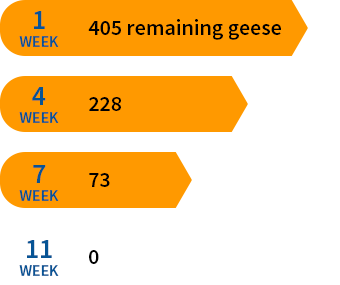
Geese cleared over 11-week program